 English
 ไทย
 မြန်မာ
 中文
 العربية
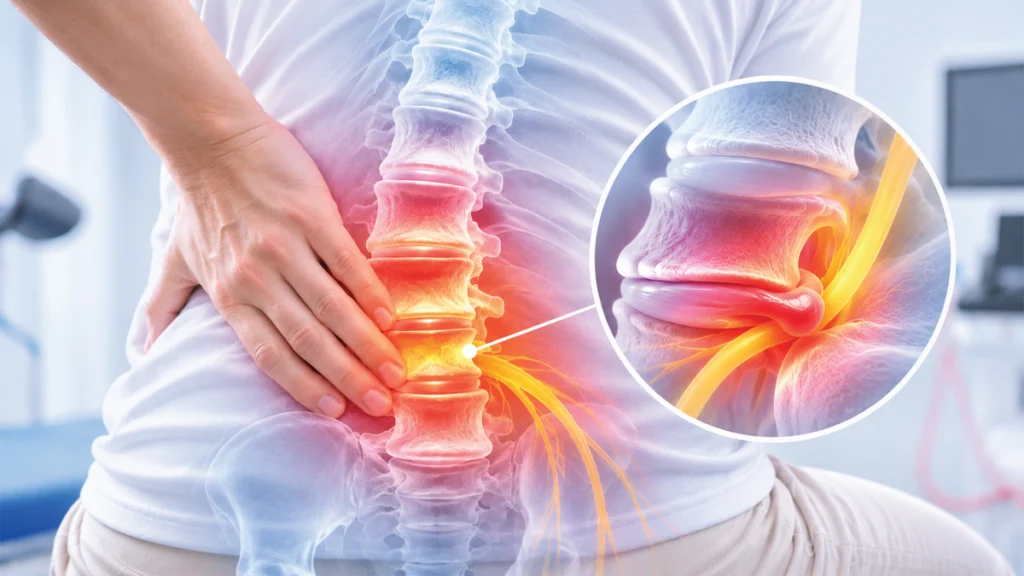
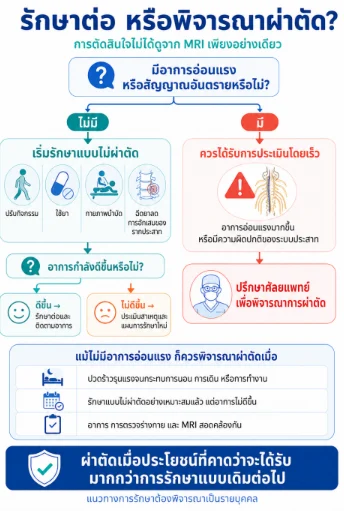
Detecting a herniated disc compressing a nerve on Magnetic Resonance Imaging (MRI) does not necessarily indicate an absolute need for surgery[cite: 1]. The treatment decision depends on whether the patient’s clinical symptoms, physical examination findings, and the lesion location on imaging correlate, as well as how significantly these symptoms impact daily life[cite: 1].
Does Finding a Herniated Disc Compressing a Nerve Require Immediate Surgery?
For the majority of patients, the answer is “not yet necessary,” particularly for those who have recently developed symptoms, have no muscle weakness, and exhibit no severe neurological deficits[cite: 1].
- Pain and Inflammation: Radiating pain down the arm or leg is not solely driven by mechanical compression, but can also arise from nerve root inflammation and irritation (Nerve Root Inflammation)[cite: 1]. Once the inflammation subsides, pain may improve significantly even if the MRI continues to show disc protrusion or herniation[cite: 1].
- Spontaneous Disc Resorption: Certain types of herniated discs can naturally regress, shrink, or be reabsorbed by the body over time[cite: 1]. This physiological process is most commonly observed in cases of disc extrusion or disc sequestration[cite: 1].
In the absence of red flags, physicians generally initiate non-surgical conservative management, including activity modification, pharmacological therapy, physical therapy, rehabilitative exercise, and, in appropriate candidates, epidural steroid injections (ESI) to alleviate nerve root inflammation[cite: 1].
Clinical Caution: Non-surgical treatment protocols must include structured re-evaluation milestones[cite: 1]. If symptoms do not improve, deteriorate, or if neurological deficits emerge, conservative therapy should not be prolonged indefinitely without re-evaluating the underlying etiology and revising the clinical treatment plan[cite: 1].
Which Symptoms Should Not Wait?
Patients should undergo urgent clinical evaluation if new motor weakness develops or if existing weakness worsens, as this serves as a critical indicator of progressive neurological compromise[cite: 1]:
- Lumbar Region: Inability to dorsiflex the ankle, walking with foot drop, difficulty standing on toes or heels, or progressive motor weakness in one lower extremity[cite: 1].
- Cervical Region: Difficulty elevating the arm, diminished grip strength, frequent dropping of objects, or progressive muscle weakness in the arm and hand[cite: 1].
(If a nerve remains compressed for an extended period, full recovery of neuromuscular function may not be completely achieved even after surgical decompression at a later stage.)[cite: 1]
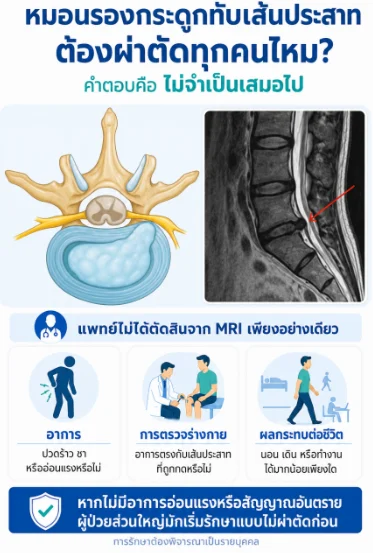
Emergency Red Flag Signs Requiring Immediate Hospitalization
- Cauda Equina Syndrome:
- Numbness and sensory loss in the buttocks, perineal region, or inner thighs in a classic saddle distribution (Saddle Anesthesia)[cite: 1].
- Urinary retention or loss of bowel and bladder sphincter control (urinary or fecal incontinence)[cite: 1].
- Bilateral lower extremity weakness.
(This clinical emergency warrants immediate neurosurgical evaluation and intervention.)
- Cervical Myelopathy:
- Gait instability, ataxia, or unsteadiness while walking[cite: 1].
- Lower extremity spasticity and stiffness[cite: 1].
- Loss of manual dexterity, difficulty buttoning shirts or handling fine objects, and frequent dropping of handheld items.
(Requires prompt evaluation by a spine specialist.)
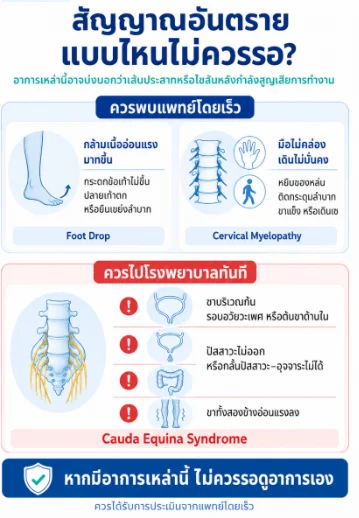
Severe Intractable Pain Without Motor Weakness: Is Surgery Warranted?
Some patients present without acute emergency signs and maintain intact sphincter control, yet suffer from severe, incapacitating radicular pain that prevents restorative sleep, limits sitting or walking to brief intervals, impairs work capability, or mandates prolonged analgesic use despite optimized conservative therapy[cite: 1].
While such clinical presentations do not constitute surgical emergencies, a spine surgical consultation is strongly recommended[cite: 1]. If severe symptoms persist and MRI findings correlate precisely with clinical symptoms and physical exam signs, surgical intervention can effectively relieve radicular pain and expedite functional recovery[cite: 1].
The Spine Patient Outcomes Research Trial (SPORT) demonstrated that while both surgical and conservative approaches offer clinical improvement, appropriately selected surgical candidates achieve superior, sustained reductions in radicular pain and significant functional recovery; therefore, symptom duration alone should not serve as the sole criterion for surgical decision-making[cite: 1].
If Pain Has Persisted for Several Months, Is Continued Observation Still Beneficial?
A clinical study published in the New England Journal of Medicine (NEJM), evaluating patients with persistent sciatica lasting 4 to 12 months due to lumbar disc herniation, demonstrated that patients undergoing microdiscectomy achieved significantly greater leg pain reduction at 6 months compared to those managed conservatively[cite: 1].
- If symptoms show progressive improvement, analgesic requirements decrease, and daily functional capacity improves, continuation of conservative management remains appropriate[cite: 1].
- If symptoms plateau without progress, worsen, or recur in a cycle of persistent medication dependence, injections, and sick leave, surgical options should be actively re-evaluated[cite: 1].
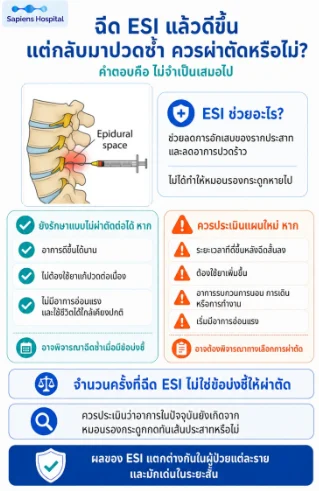
Should Surgery Be Considered if Symptoms Recur After Steroid Injections?
The answer is not necessarily in every case[cite: 1].
Epidural steroid injections (ESI) serve to reduce nerve root inflammation and alleviate radicular symptoms, but they do not anatomically resolve or eliminate the herniated disc material[cite: 1].
- Non-surgical management can be continued if: Pain relief remains durable, continuous analgesics are unnecessary, neurological deficits are absent, and near-baseline functional status is maintained (repeat injections may be considered when clinically indicated; the cumulative number of injections alone is not an indication for surgery)[cite: 1].
- Re-evaluation and surgical consideration are warranted if: The duration of symptom relief after each injection progressively shortens, medication requirements escalate, pain significantly disrupts sleep, ambulation, or work, or progressive motor weakness develops[cite: 1].
(If the primary complaint shifts toward axial neck or lower back pain with minimal radicular symptoms, alternative pain generators—such as the facet joints, SI joint, paraspinal muscles, or ligaments—should be evaluated, as discectomy is unlikely to provide relief for non-radicular axial pain.)[cite: 1]
Does Surgery Completely Eliminate All Symptoms?
While surgery has a high probability of providing substantial symptomatic relief, it does not necessarily eradicate all components of spinal pain[cite: 1]:
- Radicular Pain: Symptoms including sharp, burning, electrical shock-like pain radiating along dermatomal distributions into the upper or lower extremities respond most favorably and achieve the most pronounced clinical reduction[cite: 1].
- Axial Neck or Back Pain: Axial pain arising from degenerative disc disease, facet arthropathy, muscular strain, or ligamentous etiology may not be completely resolved by disc decompression alone[cite: 1].
Who Are the Ideal Candidates for Optimal Surgical Outcomes?
- Patients whose primary symptom is radicular pain radiating into the arm or leg along a specific nerve pathway, rather than isolated neck or low back pain[cite: 1].
- Clear clinical concordance among patient symptoms, neurological examination findings, and MRI pathology localization[cite: 1].
- Persistent, severe symptoms impairing quality of life despite an adequate course of optimized non-surgical care[cite: 1].
- Presence of clear, objectively documented motor weakness or progressive neurological deficits[cite: 1].
- Good overall surgical fitness with adequate optimization of modifiable risk factors (e.g., smoking cessation and glycemic control of medical comorbidities)[cite: 1].
Is Surgical Relief Permanent, and What Is the Risk of Recurrence?
- Recurrent disc herniation at the same spinal level occurs in approximately 5% to 10% of patients, depending on pathology characteristics, surgical technique, and follow-up duration[cite: 1].
- Long-term data from the SPORT study demonstrated that approximately 15% of patients underwent additional surgery over an 8-year period (meaning over 80% of patients did not require repeat surgical intervention)[cite: 1].
Frequently Asked Questions (FAQ)
- Is a follow-up MRI necessary once symptoms have resolved?: Generally, no[cite: 1]. Repeat MRI is only indicated when the findings have the potential to change the management plan, such as worsening symptoms, new-onset motor weakness, or surgical planning[cite: 1].
- Can patients return to normal work or sports activities after surgery?: Most patients successfully resume vocational and athletic activities[cite: 1]. Initial recovery begins with low-impact exercises (walking, swimming, stationary cycling), while high-impact athletics should be reintroduced gradually following physician clearance[cite: 1].
- Does a persistent disc herniation on MRI mean the condition is not cured despite symptom resolution?: Not necessarily[cite: 1]. MRI demonstrates anatomical structural changes but does not correlate directly with clinical symptom severity; many asymptomatic individuals demonstrate persistent disc displacement on follow-up neuroimaging[cite: 1].
- Can symptoms recur after successful recovery?: Recurrence is possible, but risk can be mitigated through weight management, regular core conditioning exercises, smoking cessation, and ergonomic posture awareness[cite: 1].
Summary
A diagnosis of disc herniation compressing a nerve does not mean that every patient requires surgery[cite: 1]. The majority of patients can initially be managed with non-operative conservative treatments[cite: 1]. Surgical consideration is warranted when persistent, severe pain significantly disrupts quality of life, when conservative measures fail, or when progressive motor deficits appear[cite: 1]. Conversely, acute manifestations such as saddle anesthesia, acute bowel/bladder dysfunction, or progressive bilateral lower extremity weakness (Cauda Equina Syndrome / Cervical Myelopathy) require emergent hospitalization and immediate specialist intervention[cite: 1].
References
- Costa F, Oertel J, Zileli M, et al. Role of surgery in primary lumbar disk herniation: WFNS Spine Committee recommendations. World Neurosurg X. 2024;22:100276. doi:10.1016/j.wnsx.2024.100276.[cite: 1]
- Xie L, Dong C, Fang H, et al. Prevalence, clinical predictors, and mechanisms of resorption in lumbar disc herniation: a systematic review. Orthop Rev (Pavia). 2024;16:121399. doi:10.52965/001c.121399.[cite: 1]
- Rashed S, Vassiliou A, Starup-Hansen J, Tsang K. Systematic review and meta-analysis of predictive factors for spontaneous regression in lumbar disc herniation. J Neurosurg Spine. 2023;39(4):471-478. doi:10.3171/2023.6.SPINE23367.[cite: 1]
- Armon C, Narayanaswami P, Potrebic S, et al. Epidural steroids for cervical and lumbar radicular pain and spinal stenosis systematic review summary: report of the AAN Guidelines Subcommittee. Neurology. 2025;104(5):e213361. doi:10.1212/WNL.0000000000213361.[cite: 1]
- Liu C, Ferreira GE, Abdel Shaheed C, et al. Surgical versus non-surgical treatment for sciatica: systematic review and meta-analysis of randomised controlled trials. BMJ. 2023;381:e070730. doi:10.1136/bmj-2022-070730.[cite: 1]
- Bailey CS, Rasoulinejad P, Taylor D, et al. Surgery versus conservative care for persistent sciatica lasting 4 to 12 months. N Engl J Med. 2020;382(12):1093-1102. doi:10.1056/NEJMoa1912658.[cite: 1]
- Vaishya S, Pojskic M, Bedi MS, et al. Cauda equina, conus medullaris and syndromes mimicking sciatic pain: WFNS Spine Committee recommendations. World Neurosurg X. 2024;22:100274. doi:10.1016/j.wnsx.2024.100274.[cite: 1]
- Fehlings MG, Evaniew N, Ter Wengel PV, et al. AO Spine clinical practice recommendations for diagnosis and management of degenerative cervical myelopathy: evidence-based decision making. Global Spine J. 2025;15(5):2585-2593. doi:10.1177/21925682251331050.[cite: 1]
- Lurie JD, Tosteson TD, Tosteson ANA, et al. Surgical versus nonoperative treatment for lumbar disc herniation: eight-year results for the Spine Patient Outcomes Research Trial. Spine (Phila Pa 1976). 2014;39(1):3-16. doi:10.1097/BRS.0000000000000088.[cite: 1]
- Zileli M, Oertel J, Sharif S, Zygourakis C. Lumbar disc herniation: prevention and treatment of recurrence: WFNS Spine Committee recommendations. World Neurosurg X. 2024;22:100275. doi:10.1016/j.wnsx.2024.100275.[cite: 1]
- el Barzouhi A, Vleggeert-Lankamp CLAM, Lycklama à Nijeholt GJ, et al. Magnetic resonance imaging in follow-up assessment of sciatica. N Engl J Med. 2013;368(11):999-1007. doi:10.1056/NEJMoa1209250.[cite: 1]