 English
 ไทย
 မြန်မာ
 中文
 العربية
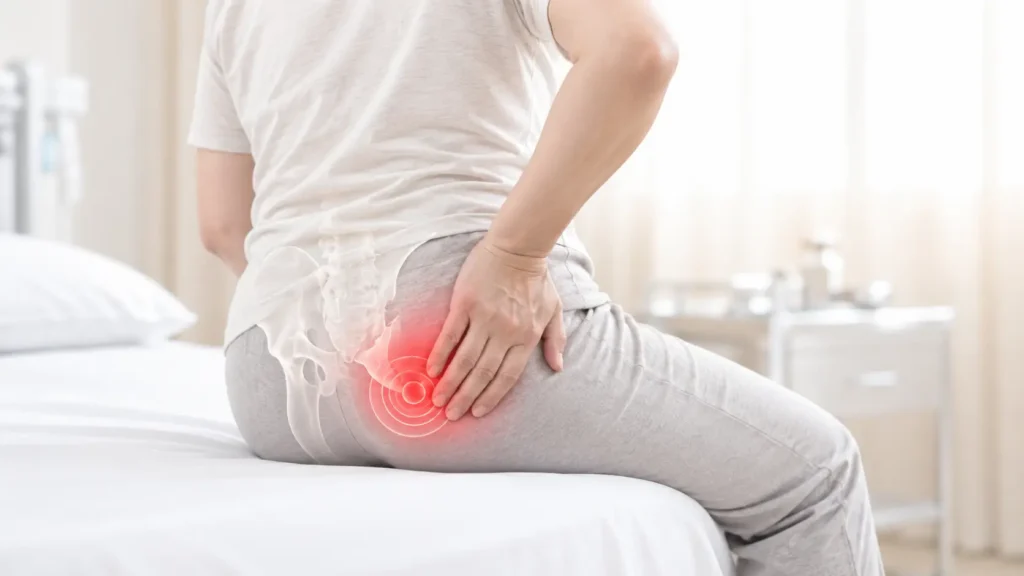
Coccydynia (or Coccygodynia) It is a condition of localized pain at the very end of the spine, which many patients often mistake for other symptoms. Lower back pain Or describe the initial symptoms as follows: My butt hurts Or deep pain in the buttocks crease, although less common than general neck or back pain, can significantly impact daily life. Patients often experience a deep, dull pain while sitting, driving, or getting up from a chair, making it difficult to sit normally for long periods and forcing them to lean to one side to avoid pressure.
Because the sacral region is a complex anatomical hub encompassing bones, joints, muscles, ligaments, pelvic tissues, and a network of nerves, identifying the source of pain (pain generator) requires evaluation by a pain specialist to differentiate conditions and plan targeted treatment.
What are the differences between tailbone pain, buttock pain, and lower back pain?
Many patients often confuse the two. Lower back pain with Tailbone pain Due to their proximity, the following initial differences can be observed:
- Location of pain: Lower back pain is typically felt in the lumbar region, above the buttocks crease, while coccyx pain is a deep pain located at the very end of the spine, in the middle of the buttocks crease (the spot patients often refer to as "butt pain" or "coccyx pain").
- Behaviors that trigger pain: Lower back pain often occurs when bending over, lifting heavy objects, or standing for long periods, but... Coccyx pain worsens suddenly when sitting down with weight on it. This is especially true when sitting on a hard chair, leaning back against the backrest, or when standing up from a seated position.
What is the coccyx and what is its function?
Coccyx The sacrum is a small bone at the very end of the vertebral column. It is formed by the fusion of 3–5 smaller bones and is located beneath the sacrum. It has two important functions:
- To support and distribute pressure. The upper body while sitting.
- It serves as a main anchor point. of the skeletal muscles, ligaments, and fascia of the lower pelvis.
When these structures become inflamed, injured, or imbalanced, they trigger intense pain nerve impulses that spread immediately when weight is applied.
Causes and risk factors of coccyx pain.
- Direct injury (Trauma): The most common causes include slips and falls, car accidents, contact sports, or injuries after vaginal childbirth.
- Coccygeal instability: Excessive or temporary displacement of the tailbone (hypermobility) or subluxation can cause repeated friction and pain in the buttocks with every sit.
- Joint degeneration and inflammation: Age-related degeneration of the coccyx joint is similar to arthritis in other parts of the body.
- Pelvic floor muscle disorders: Conditions such as chronic muscle stiffness or fasciitis include: Pelvic Floor Dysfunction or Myofascial Pain Syndrome This can cause radiating pain to the lower back and hips.
- Physical risk factors: Found in There are many times more women than men. Due to a wider pelvis and a history of childbirth, as well as those with... Overweight This increases vertical pressure on the tailbone while sitting.
Why are the X-ray results normal, but the tailbone pain persists?
A plain X-ray can only show whether large bone structures are fractured or cracked, but... Functional and soft tissue abnormalities could not be detected. For example:
- Hypermobility of the tailbone
- Inflammation of the synovial membrane of small joints.
- Deeply embedded pelvic floor muscle contractions.
A normal X-ray result does not necessarily mean there is no lesion. In patients with chronic symptoms, a specialist may consider further tests. MRI of the coccyx and lower spine. Additionally, this is done to assess soft tissue inflammation, differentiate between lumbar disc herniation and nerve compression, and screen for deep masses or infections, along with a thorough history and examination of tender points.
Multimodal Treatment Guidelines for Coccyx Pain
1. Conservative care and initial treatment for coccyx pain.
Focusing on reducing pressure and controlling inflammation in the early stages:
- Adjust your sitting habits: Avoid sitting for long periods and on hard chairs. It is recommended to use... Coccyx Cushion (Cushion with a hole for the tailbone) Designed with a gap at the tailbone to reduce direct pressure, minimizing buttock pain while sitting at work or driving.
- Medication use: NSAIDs (non-steroidal anti-inflammatory drugs) are used to reduce acute pain, and nerve signal modulators may be used in cases of severe burning or radiating pain.
- physical therapy: Stretching the hip and lower back muscles, performing manual therapy, joint alignment, and specialized pelvic floor physical therapy to relieve muscle tension.
2. Minimally invasive pain interventions.
If symptoms do not improve after 4–6 weeks of supportive care, a pain specialist may consider an outpatient procedure:
| Procedure | Mechanism of action | Effectiveness and time to see results. |
|---|---|---|
| Ganglion Impar Block | A local anesthetic mixed with an anti-inflammatory drug is injected into the sympathetic nervous system ganglion anterior to the sacrum under fluoroscopy. | Provides immediate pain relief. 40–70% Its effects last for several weeks to several months. |
| Ganglion Impar Pulsed Radiofrequency (PRF) | High-frequency radio waves are passed through the tip of a needle to modify nerve ganglia without damaging tissue (used when local anesthetic blocks are effective but pain recurs). | Extends the duration of pain relief for a longer period. 6–12 months |
3. Coccygectomy (removal of the coccyx).
is Last resort For patients with severe displaced fractures, chronic pain that significantly impacts their quality of life, and who do not respond to medication or minimally invasive procedures, the success rate is not 100%. This is because some patients may retain pain from scar tissue and ligaments around the pelvis even after the wound has healed.
4. Advanced Neuromodulation Technology
For patients with severe drug-resistant cases who have failed surgery, there are now technologies available that implant low-current electrical stimulators to disrupt the pain cycle, including:
- DRG Stimulation (Stimulates the dorsal root ganglion)
- Spinal Cord Stimulation (SCS) (Stimulates the lower spinal cord)
- Peripheral Nerve Stimulation (PNS) (Stimulating peripheral nerves)
Warning signs that require immediate consultation with a specialist.
Almost all patients with coccyx pain can recover without surgery if the source of the pain is correctly diagnosed. You should consult a pain specialist immediately if you experience the following:
- Persistent tailbone pain or buttock pain that lasts too long. 6–12 weeks
- Medication and posture adjustments have not improved symptoms, to the point where they are affecting work and driving.
- Common danger signals (Red Flags): Lower back pain radiating down the leg, leg weakness, numbness around the buttocks and perineum, sudden high fever, or a history of cancer.
Frequently Asked Questions about Coccyx Pain (FAQ)
Q: I experience tailbone pain when sitting. What sitting posture can help reduce the pain? A: You should lean slightly forward to shift your weight onto your thighs instead of your tailbone. Avoid leaning back against the chair's backrest, and use a U-shaped cushion or a coccyx cushion to prevent your tailbone from directly touching the chair surface.
Q: Can tailbone pain go away on its own? A: If the pain is caused by muscle inflammation or a minor impact, it can improve on its own within 2–4 weeks with rest, avoiding prolonged sitting, and applying warm or cold compresses as needed. However, if the pain persists for more than 6 weeks, you should consult a doctor for diagnosis.
References
- White WD, Avery M, Jonely H, Mansfield JT, Sayal PK, Desai MJ. The interdisciplinary management of coccydynia: A narrative review. PM R. 2022;14(9):1143-1154. doi:10.1002/pmrj.12753.
- Benditz A, Thoma R. Coccygodynia- Diagnosis and Treatment. Dtsch Arztebl Int. 2025;122:638-644.
- Bain HL, Mabrouk A, Foye PM. Coccyx Pain. StatPearls Publishing. Updated August 2025.
- Patil S, et al. Coccydynia: A comprehensive review on etiology, radiological features and management options. J Clin Orthop Trauma. 2021;14:1-8. doi:10.1016/j.jcot.2020.07.013.
- White WD, Desai MJ. Contemporary management of coccydynia. Curr Phys Med Rehabil Rep. 2023.
- Maigne JY, Lagauche D, Doursounian L. Instability of the coccyx in coccydynia. J Bone Joint Surgery Br. 2000;82(7):1038-1041. doi:10.1302/0301-620X.82B7.10436.
- Maigne JY, Pigeau I, Roger B. Magnetic resonance imaging findings in the painful adult coccyx. Eur Spine J. 2012;21(10):2097-2104. doi:10.1007/s00586-012-2202-6.
- Nathan ST, Fisher BE, Roberts CS. Coccydynia: A review of pathoanatomy, etiology, treatment and outcome. J Bone Joint Surgery Br. 2010;92-B(12):1622-1627. doi:10.1302/0301-620X.92B12.25486.
- Lirette LS, Chaiban G, Tolba R, Eissa H. Coccydynia: An overview of the anatomy, etiology, and treatment of coccyx pain. Ochsner J. 2014;14(1):84-87.
- Gonnade N, Mehta N, Khera PS, et al. Ganglion impar block in patients with chronic coccydynia. Indian J Radiol Imaging. 2017;27(3):324-327. doi:10.4103/ijri.IJRI_419_16.
- Sir E, Eksert S. Ganglion impar pulsed radiofrequency versus ganglion impar block for chronic coccygodynia: A comparative study. Korean J Pain. 2019;32(4):301-306. doi:10.3344/kjp.2019.32.4.301.
- Kerr EE, Benson D, Schrot RJ. Coccygectomy for chronic refractory coccydynia: Clinical case series and literature review. J Neurosurg Spine. 2011;14(5):654-663.
- Khatri SM, et al. Neuromodulation Techniques in Chronic Refractory Coccydynia: A Narrative Review. Pain Ther. 2024;13:53-67.